
How to Measure Event ROI: Formula, KPIs and Examples
Learn how to measure event ROI: the formula, the event KPIs to track for each goal, and worked examples for a conference and a brand activation.

8 min read

Event ROI tells you how much an event returned for every dollar it cost. To measure it, you need three things: a goal, the costs, and the revenue you can trace back to the people you met. This guide shows you how to measure event ROI step by step, which event KPIs to track for each goal, and two worked examples you can copy.
What Is Event ROI?
Event ROI (return on investment) compares the revenue an event generates with the total cost of running it. It is the clearest way to show whether a conference, trade show or brand activation paid for itself.
A positive ROI means the event earned back more than it cost. A negative ROI means it didn't, at least within the period you measured.
The Event ROI Formula
Here is the formula most teams use:
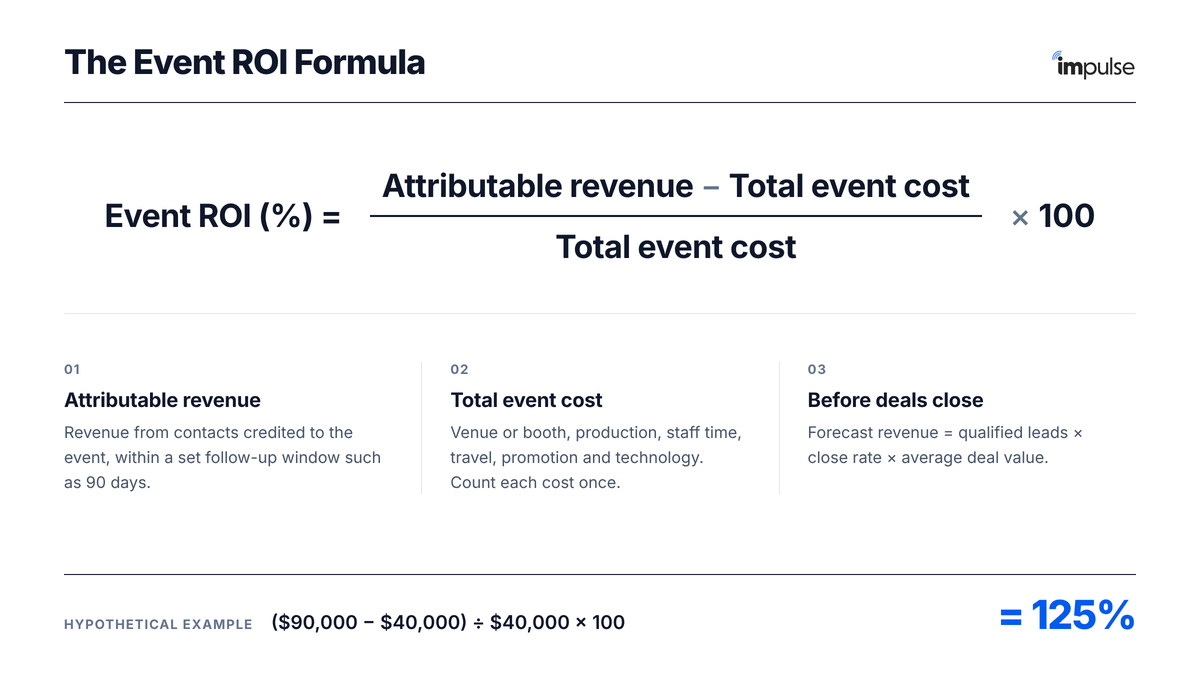
Event ROI (%) = (attributable revenue − total event cost) ÷ total event cost × 100
Attributable revenue is revenue from contacts your attribution method credits to the event, within a set follow-up window.
Total event cost is everything you spent to run the event: venue or booth, production, staff time, travel, promotion and technology.
If you want a profit view instead of a revenue view, multiply revenue by your gross margin before you subtract costs.
Before the event closes any deals, you can forecast revenue:
Forecast revenue = qualified leads × close rate × average deal value
How to Measure Event ROI in 6 Steps
Measuring event ROI starts before the event, not after it. If you don't capture contacts and costs as you go, there is nothing to measure later.
1. Set One Main Goal
Decide what the event is for. Most events have one main goal:
Lead generation: new contacts who can become customers.
Sales acceleration: moving existing deals forward.
Brand awareness: reaching new people and getting them talking.
Customer retention: keeping and growing existing customers.
The goal decides which event KPIs you track and how you judge the result.
2. Choose 3 to 5 Event KPIs
Pick a short list of KPIs that show progress toward the goal. One should be financial (revenue or pipeline), and the rest should show what happened at the event. The next section lists KPIs for each goal.
3. Capture Every Contact With Consent
You can't attribute revenue to people you didn't record. Give guests a reason to share their details, such as their event photos sent by SMS or WhatsApp, and record consent at the same time.
Tag every contact with the event name as its source. The easiest way is to send event contacts straight to your CRM, so the tag is there from day one.
4. Add Up Every Cost
List every cost, even the ones that sit in other budgets:
Venue, booth space, build and production
Staff time, travel, hotels and meals
Promotion, sponsorship fees and giveaways
Technology: registration, lead capture, photo delivery
Count each cost once. Use the same period for costs and revenue.
5. Calculate ROI at the End of Your Follow-Up Window
Choose a follow-up window that matches your sales cycle. The examples below use 90 days. At the end of the window, add up revenue from contacts tagged to the event and apply the formula.
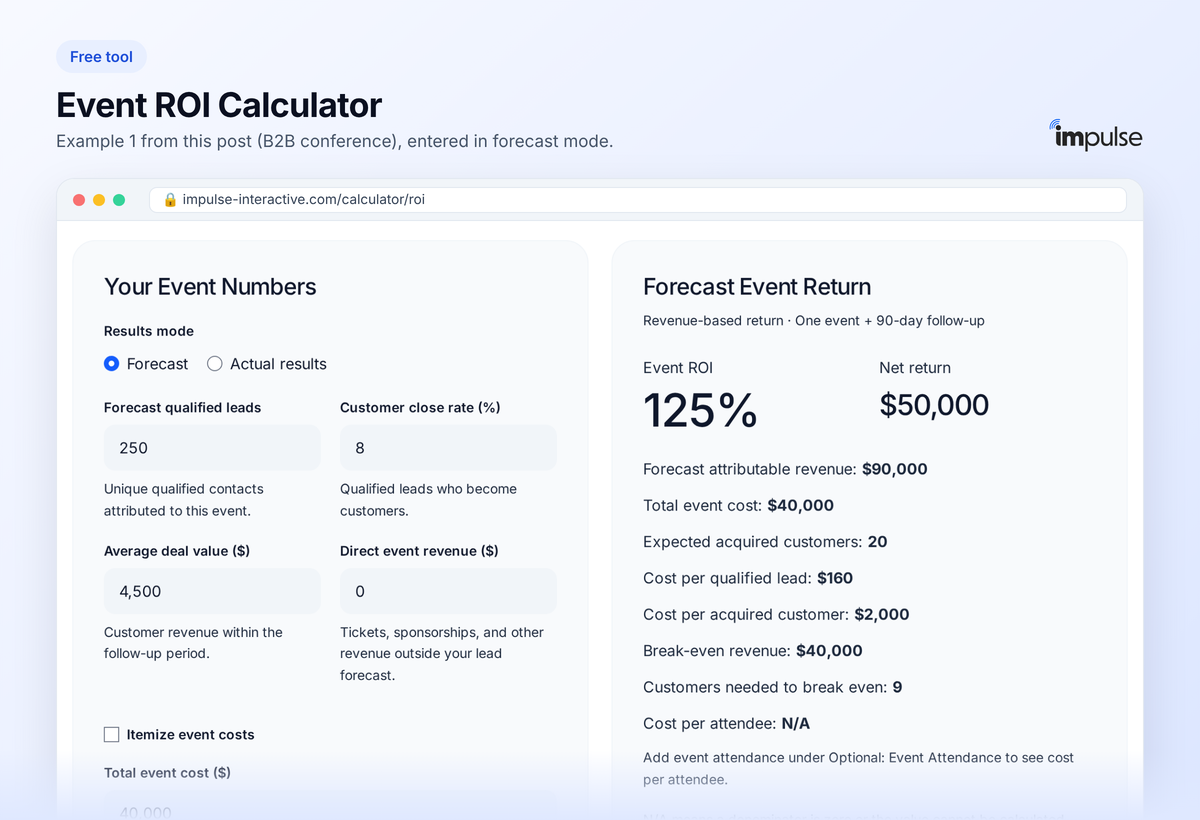
Report a forecast right after the event, then the actual ROI at the end of the window. To run the numbers, use the free event ROI calculator. It works in forecast mode and actual results mode.
6. Report ROI With the KPIs That Explain It
ROI on its own doesn't tell your team what to repeat. Put it next to the KPIs that explain it: how many guests you captured, how many became qualified leads and how many closed. The free post-event report template has a slide for each.
Event KPIs to Track for Each Goal
Event KPIs are the numbers that show whether an event met its goal. Track the ones that match your goal, and keep the list short.
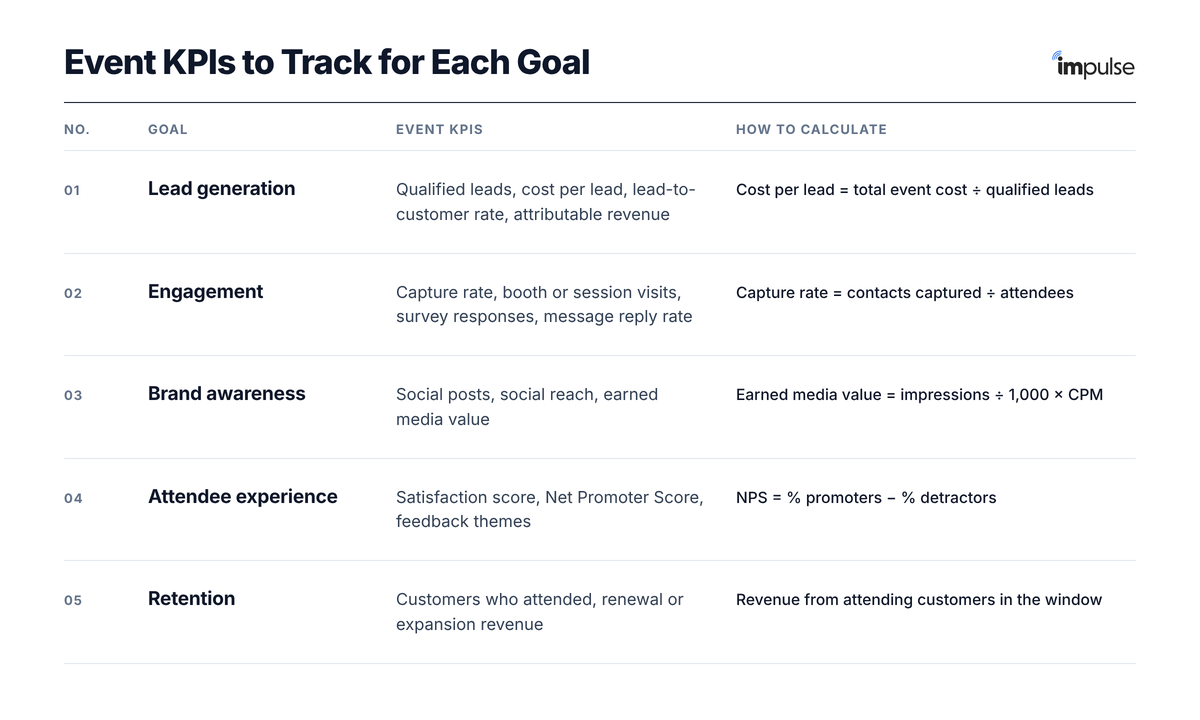
Lead generation: qualified leads, cost per lead, lead-to-customer rate and attributable revenue. Cost per lead = total event cost ÷ qualified leads.
Engagement: capture rate, booth or session visits, survey responses and message reply rate. Capture rate = contacts captured ÷ attendees.
Brand awareness: social posts, social reach and earned media value. Earned media value = impressions ÷ 1,000 × CPM.
Attendee experience: satisfaction score, Net Promoter Score and feedback themes. NPS = share of promoters minus share of detractors.
Retention: customers who attended and their renewal or expansion revenue within the window.
Lead Generation KPIs
Qualified leads count contacts who match your target buyer, not every badge scan. Cost per lead lets you compare events before deals close. Lead-to-customer rate and attributable revenue turn the leads into ROI.
Engagement KPIs
Capture rate is the share of attendees whose contact details you recorded. It drives every other number: if you capture twice as many guests, you have twice as many people who can become customers, at the same event cost.
Awareness KPIs
Awareness KPIs show reach, not revenue. Track social posts, social reach and earned media value, and report them next to ROI rather than adding them to it.
At Rare Beauty's LA fragrance launch, guests got their event photos by SMS or WhatsApp and posted them. Impulse drove 450M+ potential reach in 48 hours and $36M in media value. See how Rare Beauty reached 450M+ people in 48 hours. To estimate this for your own event, use the earned media value calculator.
Experience KPIs
Ask guests how it went while the event is still fresh, with a short survey sent the same day. Use these post-event survey questions as a starting point.
Event KPIs by Event Type
The same KPI matters differently depending on the event.
Conference booth: qualified leads, cost per lead, meetings booked and pipeline.
Trade show: leads per staff hour, cost per lead and revenue at 90 days.
Brand activation: capture rate, opted-in contacts, social reach and repeat purchases.
Sports or live event: fan signups, sponsor-branded photos delivered and sponsor survey answers. These are the numbers sponsors ask for in a sponsor activation recap.
Hosted conference: registrations, attendance rate, sponsor revenue and attendee satisfaction.
Event ROI Examples
These are hypothetical examples to show the method. They are not customer results.
Example 1: A B2B Conference
Say your team exhibits at an industry conference. You spend $25,000 on the booth, $10,000 on travel and staff time, and $5,000 on promotion and lead capture. Total cost: $40,000.
You capture 250 qualified leads. Cost per lead: $40,000 ÷ 250 = $160.
After 90 days, 20 of those leads have become customers, at an average of $4,500 each.
Attributable revenue: 20 × $4,500 = $90,000.
Event ROI: ($90,000 − $40,000) ÷ $40,000 × 100 = 125%.
Example 2: A Brand Activation
Say you run a 2-day pop-up for a beverage brand. Total cost: $30,000. 3,000 guests visit, and 1,200 sign up to get their event photos. That's a 40% capture rate.
Over 90 days, 15% of the guests who signed up redeem an offer and buy, spending $60 on average.
Attributable revenue: 1,200 × 15% × $60 = $10,800.
Event ROI: ($10,800 − $30,000) ÷ $30,000 × 100 = −64% within 90 days.
That result doesn't make the activation a failure. It tells you to judge it on a longer window, on repeat purchases, or on awareness KPIs reported next to ROI. It also shows the lever that matters most: at the same cost, every extra guest captured is another person who can buy.
Common Mistakes When Measuring Event ROI
Leaving costs out. Staff time and travel are real costs. Leaving them out inflates ROI.
Counting pipeline as revenue. Report open pipeline separately. Only closed revenue goes into ROI.
Changing the window. Use the same follow-up period for every event you compare.
Adding reach to revenue. Social reach and earned media value are not revenue.
Counting a deal twice. If a customer attended 2 events, credit the deal once.
Event ROI FAQ
What is event ROI?
Event ROI is the return an event generates compared with what it cost. It is usually shown as a percentage: (attributable revenue − total event cost) ÷ total event cost × 100.
How do you measure event ROI?
Set a goal and the KPIs that show it, tag every contact captured at the event, add up all event costs, count the revenue those contacts generate within a set follow-up period, then apply the ROI formula.
What are the most important event KPIs?
It depends on the goal. For lead generation, track qualified leads, cost per lead and revenue. For awareness, track social reach and earned media value. For engagement, track capture rate, survey responses and message replies.
How long after an event should you measure ROI?
Pick a follow-up window that matches your sales cycle, such as 90 days, and use it for every event you compare. Report an early forecast right after the event, then update it with actual revenue at the end of the window.
Can you measure ROI for a brand activation?
Yes, if you capture contacts. Count opted-in guests, then track what they buy over your follow-up window. Report reach and earned media value next to ROI, not inside it.
Should social reach count toward event ROI?
No. Social reach and earned media value are not revenue. Report them as awareness KPIs next to your ROI figure.
Start Measuring Your Next Event
Pick your goal, choose your KPIs and plan how you will capture contacts before the doors open. Then run your numbers in the event ROI calculator and share them with the post-event report template.
Impulse sends guests their event photos by SMS or WhatsApp, with no app required, and turns every signup into a first-party contact you can follow up with and attribute. Get a demo to see how it works at your next event.
Take the Next Step with Impulse
Start your journey toward more engagement, greater social reach, and data driven decisions. Use Impulse and unlock your events' full potential.